AI-driven sentiment analysis
Web, client & internal users
2026

Context
Influencer enables brands to run large-scale social media campaigns across Instagram, TikTok, and YouTube. While the platform offered strong quantitative reporting, such as impressions, reach, and engagement, clients increasingly needed qualitative insight into audience sentiment and reactions to campaign content.
At the same time, post-campaign sentiment reports were produced manually by an internal measurement team and delivered as branded PDFs outside the platform.
The Problem
Qualitative analysis (sentiment) remained outside the platform and was handled manually by the measurement team.
While this process worked well and delivered high-quality outputs, it introduced key limitations:
Sentiment analysis was not integrated into the product experience
The process relied on manual review, making it time-consuming and costly to scale
Branded client reports (PDFs) required significant manual effort to produce
Insights were not easily reusable or comparable across campaigns
As a result:
The platform only supported half of the reporting workflow
Qualitative insights could not scale in line with campaign growth
There was a clear gap between automated quantitative reporting and manual qualitative analysis
Goal
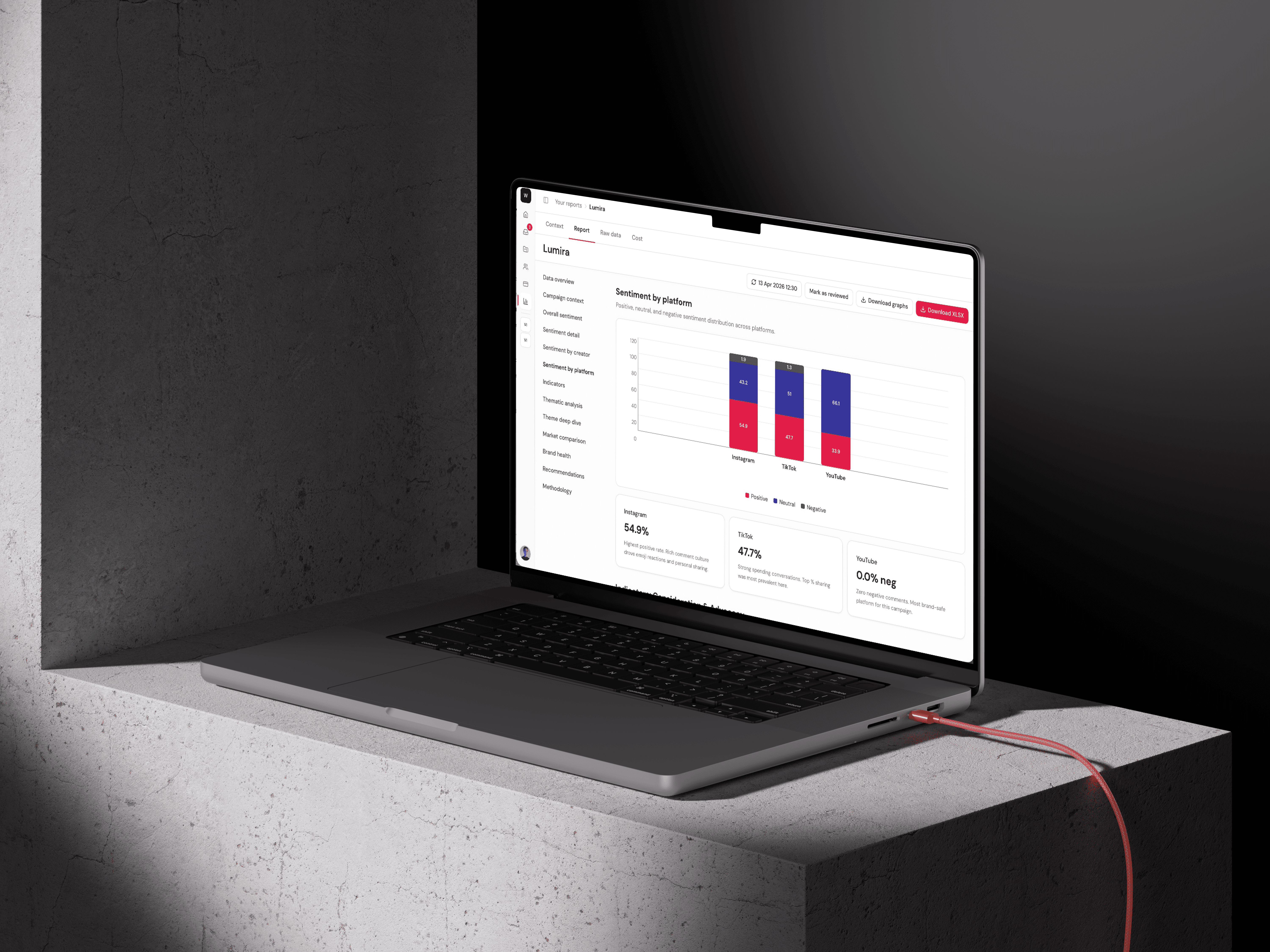
Design and deliver a sentiment analysis capability that:
Automates the manual analysis workflow performed by the measurement team
Reduces the cost and effort associated with producing branded client reports
Enables fast, consistent generation of client-ready PDF outputs
Surfaces qualitative insights alongside quantitative performance data
Explains why a campaign performed a certain way
Integrates into existing workflows while improving operational efficiency
The focus was not just on insight generation, but on end-to-end workflow optimisation, including automated report creation.
Uncovered insights
🤔 Social media language is complex
Comments often include sarcasm, slang, and mixed sentiment, making simple positive or negative classification unreliable without additional context.
🤔 High volume of low-value comments
A large portion of comments consists of emojis, spam, or generic responses, requiring filtering to surface meaningful insights.
🤔 Low trust in black-box AI outputs
Users were hesitant to rely on sentiment scores without visibility into how conclusions were formed.
🤔 Need for supporting comment evidence
Users wanted to see example comments behind each insight to validate and interpret the results confidently.
🤔 No universal definition of sentiment
Different brands and campaigns interpret “positive” and “negative” differently, requiring flexibility in how insights are defined.
🤔 Insights need structure, not raw data
Raw sentiment tagging was not sufficient. Users needed summarised themes and patterns to make insights actionable.
🤔 Manual report creation adds overhead
Even with strong analysis, translating insights into client-ready formats required additional effort and slowed down internal workflows.
🤔 Difficult to compare insights at scale
Users struggled to consistently compare sentiment across campaigns due to lack of standardised structure and outputs.
Key takeaways
• Automation must cover both analysis and report generation to deliver real value
• Sentiment without context is not actionable
• Trust and transparency are critical for AI adoption
• Operational efficiency can be as impactful as user-facing features
• Integration drives adoption, but standalone tools enable faster validation
Actionable points
• Design and implement AI-powered sentiment classification (positive, neutral, negative)
• Define and structure theme detection to surface key patterns across comments
• Create a system for custom signals (e.g. product feedback, brand perception)
• Design transparency patterns by surfacing supporting comments for each insight
• Establish UI patterns for re-analysis and refinement of AI outputs
• Define logic to filter out low-value or irrelevant comments
• Design and deliver automated branded PDF generation for client reporting
Results
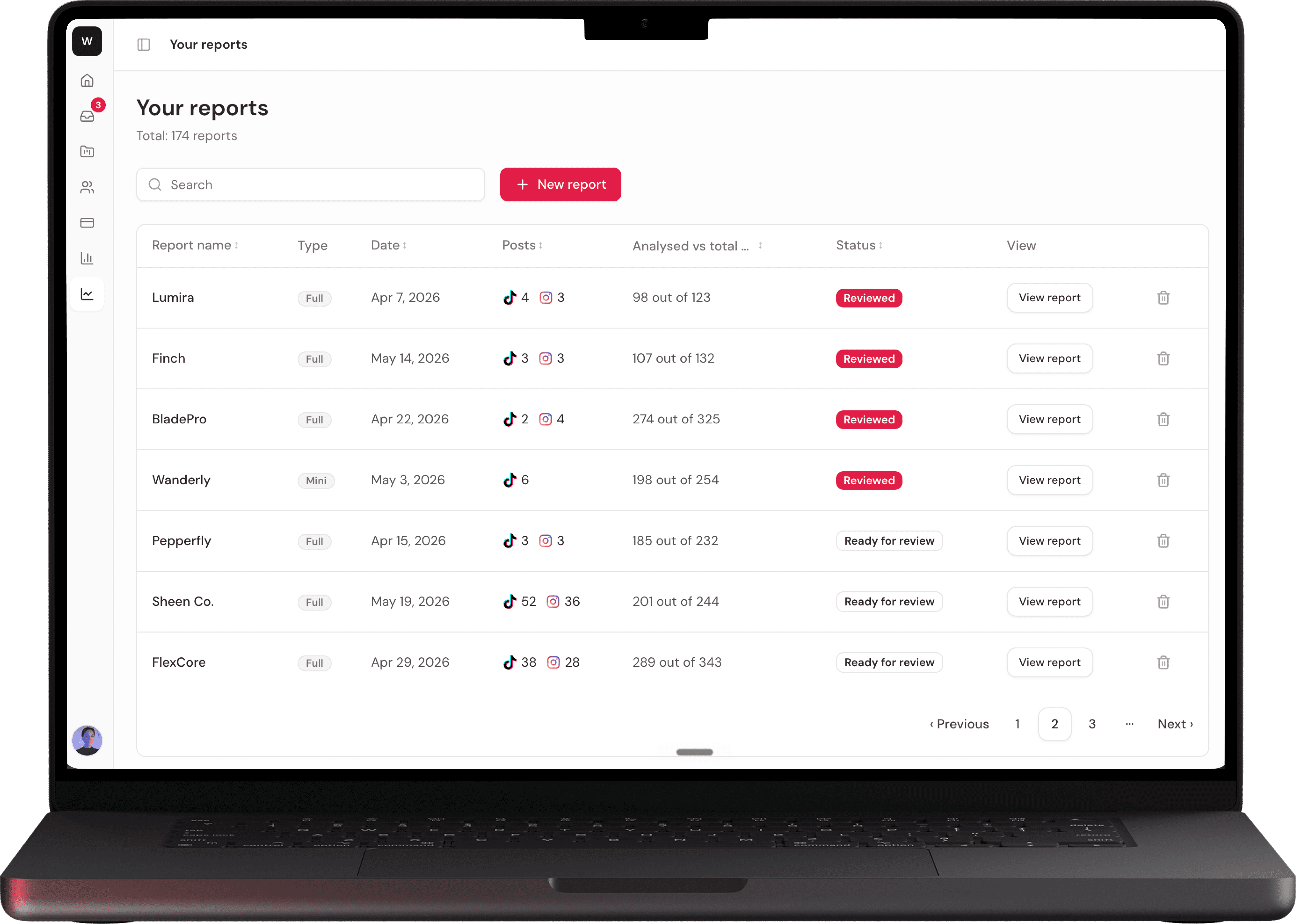
📊 Landing page with all reports
📊 New report

📊 Report generation loader

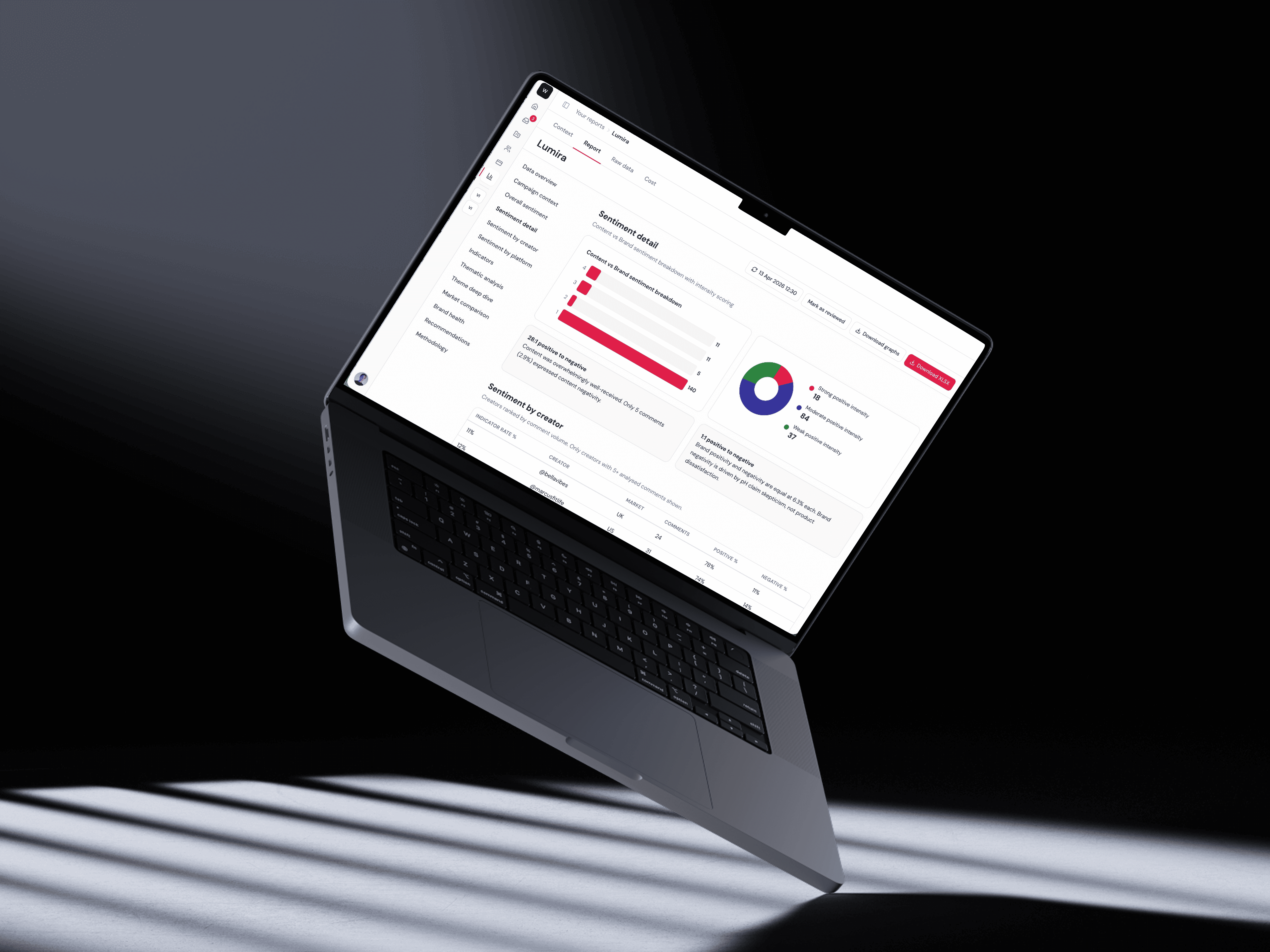
📊 Report / overall sentiment

📊 Report / market comparison

📊 Comments table

Results in detail
👍 Reduced manual effort
Automated large parts of the measurement team’s workflow, significantly decreasing the need for manual review of comments and report preparation.
👍 Automated client report generation
Introduced automated PDF outputs, reducing the effort required to create client-ready reports while maintaining quality and consistency.
👍 Lower operational cost of reporting
Minimised time and resources required to produce sentiment analysis outputs, making the process more efficient at scale.
👍 Scalable analysis across campaigns
Enabled consistent analysis across multiple campaigns, creators, and platforms without increasing reliance on manual input.
👍 Platform integrated qualitative insights
Brought sentiment analysis into the existing reporting experience, allowing users to access both quantitative and qualitative insights in one place.
👍 Improved consistency of insights
Standardised how sentiment is analysed and presented, reducing variability between different analysts and reports.
Impact
Thank you!
Previous project
Next project